There's a point in every off-page campaign where the bottleneck stops being what to do and becomes who has time to do it. You know which pages need links, what anchors are safe, and which directories are worth submitting to. What you don't have is forty hours a week to file submissions, write listing copy, chase indexing, and keep records. That gap — between knowing the strategy and producing the volume — is where most off-page programs stall.
The fix isn't to grind harder or to buy a thousand auto-approved links. It's to split the work cleanly: keep the parts that need judgement in-house, and outsource the parts that are pure repetitive production. Done right, you get more output without lowering quality. Done carelessly, you just buy the same spam that gets sites penalized. This guide is about doing it right.
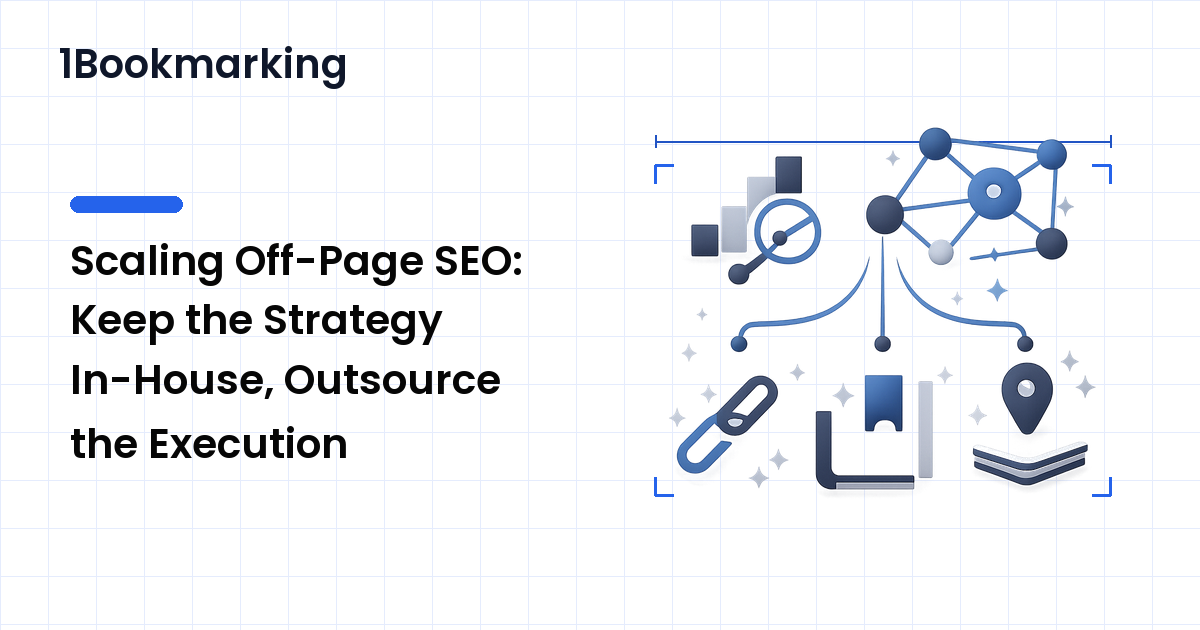
The line between strategy and production
Off-page SEO is two different jobs wearing one name.
Strategy and judgement — the part that has to stay with you:
- Deciding which pages deserve links and in what priority.
- Anchor-text planning: the ratio of branded, naked-URL, partial-match, and exact-match anchors that keeps a profile natural.
- Vetting link sources for relevance, moderation, and real traffic.
- Reading the analytics afterward and deciding what to scale or kill.
Production — the part that is repetitive labor and scales by buying time, not thinking harder:
- Filing directory and bookmarking submissions to a pre-vetted list.
- Writing and placing listing or web 2.0 copy from a brief.
- Getting submitted links crawled and indexed.
- Building consistent citations across data sources.
The mistake people make is outsourcing the first list or keeping the second. Hand a vendor your strategy and you get generic work that ignores your context. Insist on doing every submission yourself and you cap your campaign at the size of your own calendar.
Why a wholesale marketplace beats ten one-off vendors
Once you've decided to outsource production, the next trap is fragmentation: a different freelancer for bookmarking, another for directories, a third for press releases, each with their own turnaround, quality, and invoice. Managing vendors becomes its own part-time job.
This is the practical case for a wholesale SEO marketplace — a reseller platform where the common off-page services sit behind one account, one balance, and one dashboard. A long-running example is SEOeStore, which aggregates link building, social bookmarking, directory submission, citations, indexing, and press-release distribution as catalog services you order on demand. The reason this model works for off-page production specifically:
- Breadth in one place. The off-page tactics you'd otherwise source from five vendors are line items in one catalog, so you assemble a campaign instead of managing a supplier roster.
- Wholesale pricing with a margin. Because it's built for resellers, the per-unit cost leaves room for agencies to mark the work up — the difference between SEO as a cost center and as a service you sell.
- White-label and API. Orders come back unbranded, and there's an API for teams that want to push volume programmatically rather than filling forms by hand.
None of that removes your job. It removes the labor of your job. You still write the brief, choose the targets, and judge the output.
A framework for outsourcing without buying spam
The risk of any paid link service is that "cheap and fast" quietly means "low quality and risky." Keep the same scoring discipline you'd apply to a directory shortlist and you stay safe:
- Brief like you mean it. Specify the target URLs, the exact anchor distribution, and the relevance you expect. A vendor — wholesale or not — produces to the brief you give. Vague brief, generic links.
- Start with a small test order. Before you push a hundred submissions through any service, run ten. Check where they landed, whether the pages are indexed, and whether the anchors match what you asked for.
- Demand honest link attributes. A healthy off-page profile is mostly
nofollowcitations and discovery links with a few earneddofollowones. Be suspicious of anything promising "all dofollow high-DA" at volume — that's the marketing of manipulation, the same red flag covered in the social bookmarking guide. - Pace delivery. A natural profile grows steadily. Drip the work rather than spiking a thousand links in a week, regardless of how fast the marketplace can deliver.
- Measure, then reallocate. Track indexation rate, referral traffic, and movement on the target pages. Keep the service tiers that produce signal; stop buying the ones that don't.
What to keep on your own desk
Outsourcing production frees time — spend it on the work that actually compounds: earning genuinely editorial links through outreach, building relationships, and creating link-worthy assets. No marketplace can manufacture those, and they're what separate a durable profile from one built entirely on bought volume. The right balance for most programs is a base of outsourced citations, bookmarking, and indexing handling the breadth, with your in-house effort focused on the high-authority links that need a human relationship.
FAQ
Is buying off-page SEO services against Google's guidelines?
Buying links to manipulate rankings is against guidelines. Buying production labor — submission, citation building, indexing, distribution — for legitimate, relevant placements is a normal operational decision. The risk lives in the quality and intent of what's placed, not in the fact that you paid someone to file it.
How do I know a wholesale service isn't just selling spam?
Test before you scale. Order a small batch, then check relevance, indexation, link attributes, and whether anything reads auto-generated. Score the output the same way you'd score a directory before submitting. Quality varies by service tier even within one marketplace, so judge the tier, not just the platform.
What should I never outsource?
Your anchor-text strategy, your target-page priorities, and your measurement. Those are judgement calls specific to your site's profile and risk tolerance. Outsource the hours, not the decisions.
Does a reseller marketplace make sense for a single site?
It can, even without reselling — the value is consolidating off-page production behind one account instead of juggling vendors. Agencies get the extra benefit of white-label delivery and wholesale margin, but a solo site owner mainly gets back their calendar.
Next step
Draw the line first: list every off-page task in your current campaign and mark each one judgement or production. Keep the judgement column. For the production column, brief one service, place a small test order through a wholesale marketplace like SEOeStore, and measure it before you scale — exactly the discipline that keeps outsourced off-page work an asset instead of a liability.