Most link campaigns are planned backwards. Someone picks the keyword, opens the site, finds the URL that targets it, and writes that URL into every outreach email and every submission form. Then the campaign underperforms, and the diagnosis is always about the links — not enough of them, not strong enough, wrong anchors.
Often the links were fine. The destination was wrong.
The short version: the page you want to rank is frequently the worst page to ask for a link to, because the qualities that make a page commercially valuable are the same ones that make nobody want to cite it. Choosing a link target is its own decision, with its own criteria, and it is separate from choosing which page you are trying to rank. Get the separation right and internal links do the rest.
Choose on what the page can host, not what you want from it
Before comparing the options, it helps to have criteria that apply to all of them. A page is a good link target when most of these are true:
- A real editor could link to it without being paid or persuaded. If the only reason a link exists is that you asked, you are building a pattern rather than earning a reference.
- It gives an arriving visitor something. Referral traffic that bounces instantly is a signal you don't want attached to a page you care about.
- It can pass what it earns onward. A page with no outgoing internal links is a cul-de-sac. This is the criterion people forget, and it is the one that decides whether the campaign works.
- It is close enough to benefit. Authority does not teleport. A page several clicks from the link is barely touched by it.
Only the fourth of these has anything to do with rankings. The first three are about whether the page deserves a link at all.
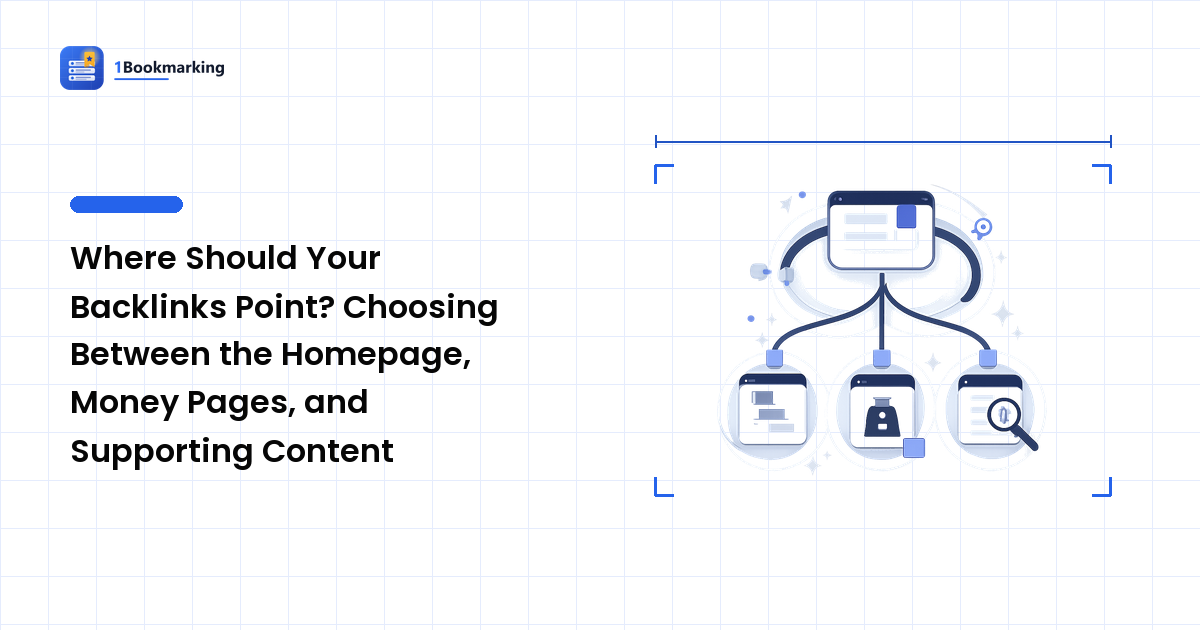
The four realistic targets, and what each is good at
The homepage
Good at: absorbing almost any kind of link without looking manufactured. Directory listings, citations, profile links, press mentions, partner pages and sponsorships all point at homepages in the wild, so a homepage-heavy profile looks normal on the surfaces those links come from. Brand anchors are natural here, which sidesteps most anchor risk.
Weak at: routing. Whatever the homepage earns has to travel down through your internal structure to reach the page that needs it, and every click of distance costs something.
Choose it when: the site is new and has no other page worth citing yet — the sequence for that case is in how to build the first links to a brand-new site — or when the source is a citation, a profile, or a brand mention, where a deep link would look odd.
A category or hub page
The most underused of the four. A well-built category page sits between the homepage and the commercial pages, usually has content of its own, and links to every child page beneath it.
Good at: being a legitimate destination for a broad, informational reference, then distributing what it receives across a whole set of pages at once.
Weak at: being link-worthy on its own. A thin category page that is just a grid of products gives a prospective linker nothing to point at.
Choose it when: the source is writing about your subject area rather than one specific product, and you have more than one page you'd like to lift.
The commercial page you actually want to rank
Good at: proximity. Nothing is lost in transit, because the value arrives exactly where you need it.
Weak at: almost everything else. Pricing pages, service pages and product pages are the hardest links to earn honestly, because they exist to sell rather than to inform. And a profile where the commercial pages carry a disproportionate share of links — usually with commercial anchors attached — is the textbook over-optimisation pattern; anchor text over-optimization covers how that distribution goes wrong.
Choose it when: the placement genuinely calls for it — a review, a comparison, a roundup of tools in your category. In those contexts a link to the product page is what a reader expects, and anything else looks evasive.
A supporting asset built to be linked
A guide, a calculator, an original data piece, a template, a reference table. This is the one target on the list you can change in order to make links easier to get.
Good at: earning links at a rate the other three can't match, and doing it with natural anchors.
Weak at: commercial relevance. An asset that never links onward to anything that makes money is a vanity project with good metrics.
Choose it when: you have the capacity to build one, and the discipline to connect it internally to the page it is supposed to help.
The trade-off the category hides
Every candidate target sits somewhere on a line between easy to earn and close to the page that needs it, and no target is both.
The homepage and a supporting asset are easy to earn links to and far from your commercial pages. The commercial page is close and hard to earn. The category hub sits in the middle on both counts, which is exactly why it deserves more attention than it gets.
Most advice names only one end of that line. "Build deep links, not homepage links" ignores how hard deep links are to get honestly. "Point everything at the homepage" ignores how much is lost on the way down. The useful question is not which end is right, but which end your constraint is on: if you can't earn links to the commercial page, the answer is not to earn them badly — it is to earn them elsewhere and route them.
How value actually reaches the page that needs it
Routing is an internal-linking job, and it is the step most campaigns skip.
Three rules of thumb — offered as rules of thumb, not measurements:
- Keep the linked page within a click or two of the page it's meant to help. The further the distance, the less arrives.
- Put the internal link in body copy, with a descriptive anchor. A link in a sidebar template that appears on every page carries less weight than one placed deliberately in context.
- Make the internal link useful to the reader too. If someone landing on your guide would sensibly click through to the commercial page, the link is doing two jobs. If they wouldn't, you have chosen the wrong asset.
Why fixed ratios mislead
You will see prescriptions like "70% deep links, 30% homepage." These describe an outcome, not a plan, and the outcome differs by business.
A local services company that builds citations and directory listings will always be homepage-heavy, because that is what those surfaces link to — and that profile is natural for that business. A software company that publishes a reference document will be asset-heavy, equally naturally. Copying either ratio onto a business that earns links differently produces a profile engineered to hit a number, which is the opposite of the goal.
The honest test is the one that applies to all off-page work: could this distribution have arisen from people linking to you for their own reasons? If yes, the ratio is right for you. Our off-page SEO strategy guide covers how link targeting fits into a campaign as a whole.
What this changes about prospecting
One practical change: add a column to your prospect sheet for intended target, and the reason. Fill it in at the prospecting stage, not the outreach stage.
The moment you do, the question you carry into each opportunity flips. You stop asking "who will link to my product page" — a question with very few honest answers — and start asking "what on my site is a plausible destination for this source." That question you can usually answer, and answering it well is most of the difference between a campaign that moves rankings and one that only moves counts.
FAQ
Is it a problem if most of my links point at my homepage? Not by itself. For many businesses it is the natural shape. It becomes a problem when nothing internally routes that value onward, or when the homepage is the only page anyone has ever had a reason to cite — which is a content problem, not a link problem.
Should I build links to a blog post that doesn't convert? Yes, if it links internally to something that does. That is the whole mechanism behind supporting assets. The case to avoid is the post that converts nothing and links to nothing.
How many links does a page need before it moves? There is no number, and anyone who gives you one is guessing. The workable substitute is comparative: look at what the pages currently ranking for your term have earned, and treat that as the neighbourhood you need to be in rather than a target to hit.
Do internal links really move value from one page to another? They are how the value moves at all — search engines follow links, internal ones included. Internal links are the only part of this system you fully control, which makes them the cheapest lever available and the most consistently neglected.
Decide the destination before you write the pitch. The page that can host a link and the page you want to rank are two different choices, and treating them as one is why good placements so often produce nothing. For submission and bookmarking opportunities to build against once you know where they should point, see 1Bookmarking.