Open the billing page of almost any small SEO team and you'll find the same picture: two or three subscriptions that each sell a backlink index, plus a rank tracker, plus something for outreach. The overlap is enormous and mostly invisible, because nobody bought the tools at the same time — they were added one problem at a time, and no one ever went back to cancel.
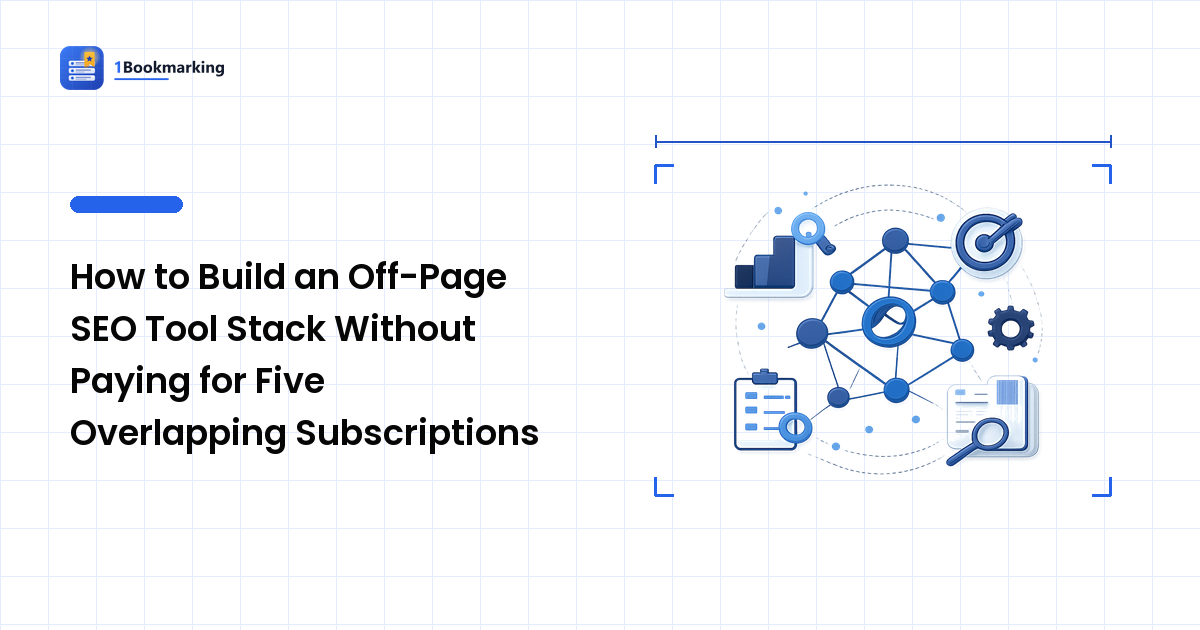
The takeaway up front: build your stack around the five jobs off-page work requires, not around brands. Four of those five jobs have a serious free option that most teams already have access to. The one that genuinely justifies paid tooling is the third-party link index — and you only need one of those, not three. Everything below is a buying framework you can run against your own invoices this week.
The five jobs an off-page stack has to do
Every link-building workflow, whatever tactic it uses, breaks into the same five stages. Tools should be bought against these jobs, and a tool that only does one of them well is not automatically worse than a suite that does four of them adequately.
- Prospecting — generating a list of candidate sites, directories, or bookmarking platforms worth pursuing.
- Vetting — deciding which candidates are worth your time and which are a liability.
- Execution tracking — knowing what you submitted or pitched, where, when, and with what anchor.
- Verification — confirming the link went live, is crawlable, and got indexed.
- Measurement — connecting the work to referring domains, rankings, and referral traffic.
Miss any one of these and the others degrade. Prospecting without vetting fills your profile with landfill. Execution without verification means you never learn that a third of your submissions silently expired. Our off-page SEO strategy guide covers how the stages fit into a campaign; this piece is about what to run each one on.
Job 1: Prospecting — mostly a search skill, not a tool purchase
Prospecting is the job people most often over-buy for. The core technique is search-operator work you can do in a browser: site-restricted searches on known platform footprints, intitle: and inurl: patterns for submission and resource pages, and reverse-engineering the sources that already link to comparable sites in your niche.
What a paid tool adds here is speed and competitor link intersection — pulling every domain linking to three competitors but not to you. That is a genuinely useful shortcut, and it comes free with the index subscription you'll buy in Job 2. It is not a separate line item.
What you do need is somewhere to put the output. A single spreadsheet with a fixed column set (domain, discovery source, category, contact route, status, date, anchor used) beats a dedicated prospecting product for any team under about five people, because the bottleneck is your judgment, not your storage.
Free tier that works: browser search operators, a spreadsheet, and Google Search Console's Links report to see who already links to you (worth checking before you prospect — you'll find categories of site you'd never have guessed).
Job 2: Vetting — this is where paid tools earn their money
This is the one job where free options genuinely fall short, and it's worth understanding why. Google does not publish a public link graph. Every "authority" number you have ever seen — Moz's Domain Authority, Ahrefs' Domain Rating, Semrush's Authority Score, Majestic's Trust Flow and Citation Flow — is a vendor's estimate built from that vendor's own crawl. They are not Google metrics, they don't agree with each other, and they can be gamed.
That doesn't make them useless. It makes them a first-pass filter that must be followed by human checks. The vendor score tells you which 200 of your 2,000 candidates deserve five minutes of attention; it never tells you the link is good. The manual checks that actually decide it — is the site indexed, does it get organic traffic, is the content editorially maintained, is the outbound-link pattern sane — are laid out in our guide to judging backlink quality before you build it.
Buying rule: own exactly one link index. Two indexes covering the same crawl is the single most common wasted subscription in off-page SEO. Pick on the basis of crawl freshness, how quickly newly discovered links appear, and whether the interface makes link intersection and lost links easy — those two reports do more day-to-day work than any score.
Free tiers that meaningfully reduce the bill: Google Search Console's Links report (your own profile only, and the export is capped, so treat it as a sample rather than a census); Bing Webmaster Tools, which also exposes backlink data for verified properties and costs nothing; and Ahrefs Webmaster Tools, which gives verified site owners backlink data for their own domains at no charge. The catch on all three is the same: they only show your site, not your prospects. That gap is precisely what you're paying an index for.
Job 3: Execution tracking — a spreadsheet until it hurts
Submissions and outreach both need a record of what happened. Dedicated outreach platforms with mailbox integration, sequences, and reply detection are worth real money once your volume passes the point where you'd lose track manually — usually somewhere around ongoing conversations with dozens of sites at once, or a team where two people might pitch the same editor.
Below that, a shared sheet with a status column and a follow_up_on date does the job, and has the advantage of forcing you to look at your own pipeline. Do log the anchor text you requested on every row: anchor distribution is only auditable if you recorded it at the time, and retrofitting it later is miserable.
Job 4: Verification — cheap, skipped constantly, high payoff
A submitted link and a counted link are different things. A listing can go live nofollowed, get placed on a page that is itself not indexed, sit behind a redirect chain, or quietly disappear at renewal. If you don't check, your reporting is fiction.
The verification stack is genuinely inexpensive:
- A crawler to fetch your live link list and report status code, final URL after redirects, and the
relattribute on your link. Screaming Frog's SEO Spider is free up to 500 URLs per crawl, which covers most campaign batches; run it in list mode against your placements sheet. - The URL Inspection API in Search Console, to check the indexing status of the linking pages you control or can query, with a documented quota of 2,000 requests per day per property.
- A site search on the linking URL as the crude fallback when nothing else is available.
Why this matters more than it sounds: a link on a page Google has never crawled contributes nothing at all until discovery happens. Our backlink indexing guide covers what to do with the ones that fail this check.
Job 5: Measurement — three numbers, one baseline
Off-page measurement collapses to a small number of series, tracked over months rather than days:
- Referring domains over time (from your one index), not total link count — counts inflate with sitewide footers and tell you very little.
- Rankings for the specific pages you built links to, from a rank tracker, checked from a fixed location and device.
- Referral sessions and assisted conversions from the placements themselves, in your analytics platform. Directory and bookmarking placements are often judged only on link value when a slice of them are actually sending qualified people.
Write down the baseline before the campaign starts. Almost every argument about whether link building "worked" is really an argument about a baseline nobody recorded.
The overlap audit: run this against your invoices
Print your current subscriptions and tag each one with the jobs it does. Then look for these three patterns:
| Pattern | What it looks like | Fix |
|---|---|---|
| Duplicate index | Two or more tools whose main output is backlink data | Keep the one with the freshest crawl for your market; cancel the other |
| Suite tax | An expensive all-in-one bought for a single report | Check whether the free tiers plus one focused tool cover it |
| Zombie seat | A tool nobody has opened in a quarter | Cancel; you can always re-subscribe when the need returns |
The realistic destination for most small teams: free webmaster tools for your own data, one paid link index, a free-tier crawler, a rank tracker, and a spreadsheet — with outreach software added only when volume forces it.
FAQ
Do I need a paid backlink checker if I have Search Console? For auditing your own profile, often no — Search Console plus Bing Webmaster Tools plus Ahrefs Webmaster Tools covers your own domain at no cost. The moment you need to evaluate someone else's site as a prospect, or compare competitors, you need a third-party index. That's the boundary.
Which authority metric should I filter prospects on? Whichever one comes with the index you bought — they broadly rank sites in a similar order, and consistency matters more than the specific brand. What matters far more is treating the score as a triage filter with a deliberately generous threshold, then spending the time saved on manual checks of the survivors.
Is it worth paying for an indexing service to push links into the index? Be careful here. The reliable levers are making the linking page discoverable and worth crawling. Services promising to force indexing vary enormously in method, and some use techniques that reflect badly on the pages involved. Diagnose first: check whether the linking page itself is indexed before assuming the link needs a push.
How much should a small team's off-page stack cost? There's no honest universal number, but the shape is consistent: one meaningful subscription plus free tiers. If you have three or more paid tools and fewer than three people, the odds are strong you're paying twice for the same crawl.
Next step
Audit before you buy. Map your current tools onto the five jobs, find the duplicate index, and put the saving toward the one gap you actually have — usually verification discipline rather than another dashboard. A stack that covers all five jobs adequately beats a stack that covers two of them brilliantly and leaves your placements unverified.
When you're ready to fill a gap, browse the curated SEO tool collections for agencies and freelancers — categorised shortlists with a stated reason for every pick, so you can compare on the job you're actually hiring the tool to do.