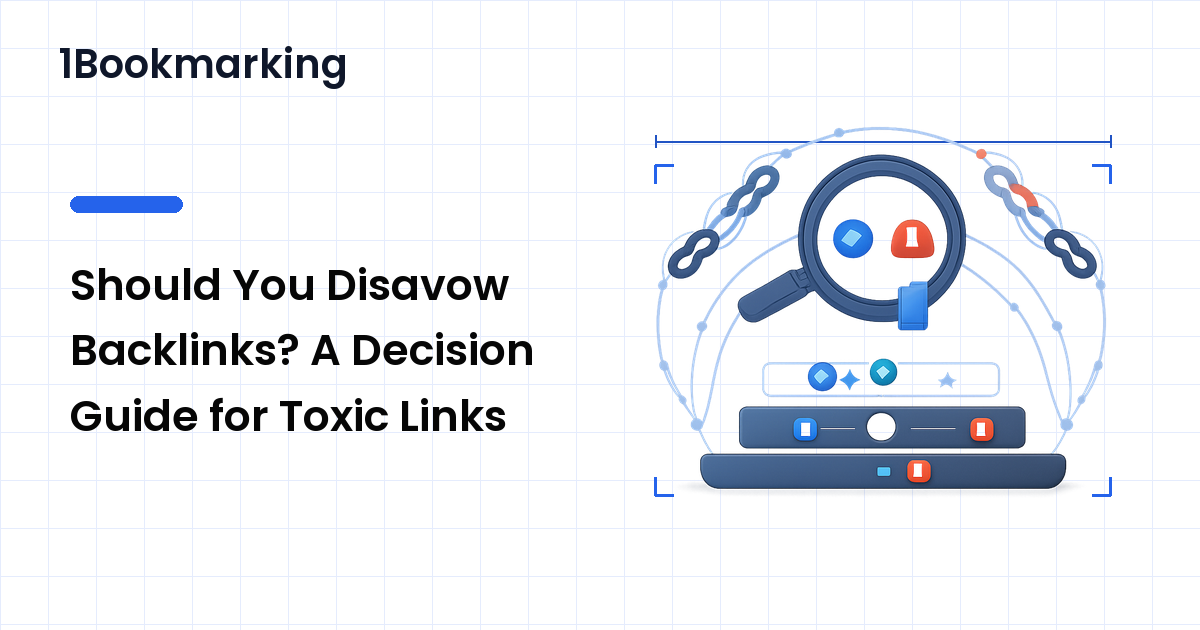
A backlink-audit tool flags 340 of your links as "toxic," paints your dashboard red, and tells you to disavow them all. The instinct is to upload the list to Google immediately and make the scary number go away. Resist it — that instinct is how site owners quietly delete authority they spent years earning.
The takeaway up front: the disavow tool is a last-resort fix for a specific problem, not routine link hygiene. Google's own guidance is that most sites will never need it, because its systems already ignore spam algorithmically. A third-party "toxicity score" is a vendor's guess, not a Google signal. Disavowing should be a deliberate, evidence-led decision — and for the large majority of sites, the correct decision is to do nothing.
What disavow actually does (and doesn't)
The disavow tool tells Google: don't count these links when assessing my site. You upload a text file of URLs or, more commonly, whole domains, and Google treats those links as if they carried no weight — neither positive nor negative. It does not remove the links from the web or delete them from your backlink reports. They still exist; Google just stops attributing them to you.
Two things people miss: it's blunt — a domain: line discounts every link from that domain, including good ones you'd forgotten were there — and it's slow, taking weeks to reprocess, with each upload replacing the previous list rather than adding to it. This is not a dial you nudge weekly; it's a one-time intervention for when you have a real reason.
Who actually needs to disavow — and who doesn't
Strip away the tool-marketing fear and the genuine use cases are narrow. You have a real reason to disavow only when both of these are true:
- You have a considerable volume of spammy, artificial, or low-quality links pointing at you, and
- those links have triggered a manual action — or are clearly about to.
In practice that's one of two situations: Google sent you an "unnatural links" manual action (Search Console → Security & Manual Actions), or you previously bought links or ran a link scheme you can't get taken down. In both, the links are ones you (or someone you paid) deliberately built, and they're now a liability.
Who does not need the tool, despite the red dashboards:
- Sites with no manual action. If Search Console shows none and rankings haven't fallen off a cliff, Google is almost certainly already ignoring the junk. Disavowing gains nothing and risks harm.
- Sites hit by "negative SEO" spam. Floods of foreign-language anchors, scraper copies, and forum-spam links look alarming but are exactly what Google's algorithms discount automatically. Google says repeatedly that most sites should not file a disavow for this.
- Anyone acting purely on a third-party toxicity score. Those are heuristics — anchor patterns, spam signals, low domain metrics — not a Google signal. They flag plenty of links Google handles fine, and routinely flag legitimate links as toxic.
The honest summary: no manipulative links you built and no manual action means you're probably in the "do nothing" majority.
The over-disavow trap (the expensive mistake)
The most common disavow disaster isn't failing to disavow — it's disavowing too much. Upload a tool's "toxic" list wholesale and you almost always sweep in links that were helping you: a real mention on a small blog with low domain authority, a niche directory that looks thin to an algorithm, a forum thread that sends relevant traffic. Discount those and you hand back hard-won authority — and can watch rankings drop, not recover.
It's worse than it sounds because disavow has no clean undo: removing a domain later doesn't instantly restore its prior credit. You're making an irreversible-in-practice bet on a vendor's guess. So apply one test to every candidate: Did I (or someone I paid) place this link to manipulate rankings? If yes, it's a candidate. If it just looks low-quality but arose naturally, leave it — that's exactly the kind of link Google expects and is built to ignore.
How to run a real backlink audit first
If you genuinely meet the bar — manual action, or known bought/schemed links — don't disavow blind. Audit first, and disavow only what survives scrutiny.
- Pull the full picture. Export from Search Console's Links report — the set Google actually attributes to you — and supplement with a backlink tool for coverage.
- Split "placed" from "earned." Tag every linking domain as I built this or this happened on its own. This single split does most of the work — your disavow candidates live almost entirely in the "I built this" column.
- Read the suspects manually. An obvious PBN, link farm, or forum spam at scale with exact-match anchors — or a real (if modest) site? Algorithms can't tell; you usually can in seconds.
- Try removal before disavow. For links you control or can request, getting them taken down is cleaner. Disavow is the fallback for what you can't remove.
- Disavow only the confirmed-manipulative remainder — and prefer
domain:lines for whole spam networks, since listing individual URLs from a PBN is a losing game of whack-a-mole.
The audit's whole value is separating links you engineered from links that simply exist — only the first kind belongs anywhere near a disavow file. And whether a flagged link even counts is a prior question: a surprising share of "scary" links were never crawled or indexed, so they pass nothing regardless. See the backlink indexing guide.
Doing it correctly when you must
If the audit leaves you with a real list, the mechanics are simple but unforgiving.
- Build a plain-text file, one URL or domain per line, UTF-8 or ASCII, ending in
.txt. Usedomain:shadyseo.exampleto discount a whole domain; leave it off to target a single URL. Annotate with#comment lines noting why and when. - Upload via the disavow tool, selecting the exact property. It replaces that property's existing list, so always upload the complete current list, not just new additions.
- A manual action means disavow is only half the job. After uploading, file a reconsideration request documenting what you did — links removed, links disavowed and why. Disavow alone doesn't lift a manual penalty; the reconsideration request is what asks a human to re-evaluate.
- Then wait. Reprocessing takes weeks as Google recrawls. Don't re-upload daily or panic at flat results in the first fortnight.
FAQ
Do toxic backlinks actually hurt my rankings?
Usually not on their own. Google's systems are built to ignore spammy, manipulative links automatically, so for most sites a pile of junk links is noise the algorithm discounts. Toxic links become a real problem mainly when you deliberately built manipulative links at scale, which can earn a manual action.
Should I disavow links if I don't have a manual action?
In almost all cases, no. If Search Console shows no manual action, Google is most likely already ignoring the bad links, and disavowing risks accidentally discounting good ones. Reserve the tool for when you have (or clearly expect) a manual action for unnatural links, or you can't remove links you yourself placed in violation of guidelines.
Are third-party "toxic link" scores reliable?
Treat them as a starting point, not a verdict. Toxicity scores are heuristics based on anchor text, domain metrics, and spam patterns — they're not a Google signal. They frequently flag links Google handles fine, and sometimes flag legitimate links you'd be foolish to discard. Always confirm manually before disavowing anything a tool reports as toxic.
How long does a disavow take to work?
Plan on a few weeks. Google has to recrawl and reprocess the affected pages before the disavow file takes full effect, and any ranking impact follows from there. If you also filed a reconsideration request for a manual action, the human review adds its own time. Don't expect overnight changes, and don't keep re-uploading while you wait.
Next step
Before you disavow a single link, do the boring, decisive work: check Search Console for a manual action and split your linking domains into links I placed and links that simply happened. No manual action and no manipulative links you built? Close the tab and leave the tool alone. If you do meet the bar, disavow only the confirmed-manipulative remainder and pair it with a reconsideration request. The goal isn't a cleaner toxicity score — it's not deleting authority you can't easily get back. Start that audit at 1bookmarking.com.